
Texan Eye — Surgical Vision Correction
Beyond Glasses.
Two Proven Paths.
For most of your life, glasses and contacts were your only options. Today, Texan Eye offers LASIK and Refractive Lens Exchange, two surgical procedures that can give you clear vision at every distance.
- LASIK for nearsightedness, farsightedness, and astigmatism
- Full Focus® RLE for presbyopia and high prescriptions — eliminates future cataracts
- Free LASIK screenings at our Austin and Cedar Park offices
Is This Right for You?
Am I a Candidate for Surgical Vision Correction?
Most people develop cataracts with age. If any of the following sound familiar, it may be time for an evaluation.
The right procedure depends on your specific eyes. A thorough eye examination is required before any recommendation is made — to rule out ocular conditions that would make surgery inadvisable and to determine the most appropriate treatment plan. Schedule a consultation appointment with Texan Eye to find out which option is right for you.
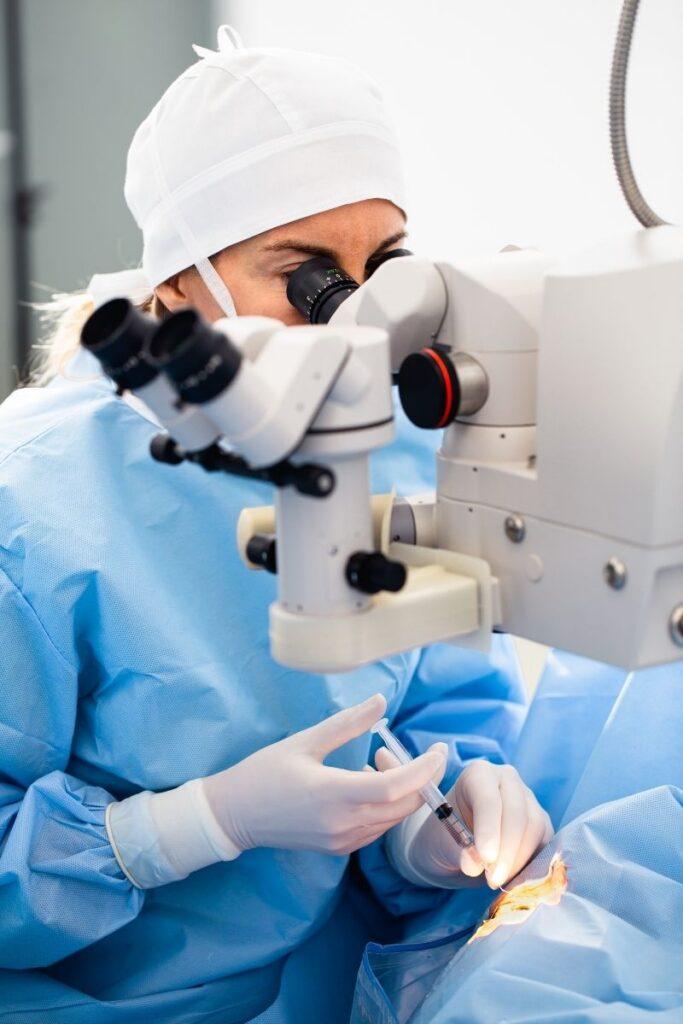
The Procedures
What Is Surgical Vision Correction?
For many years, the only valid option a patient had to correct blurry near vision that we nearly all experience sometime after the age of forty was glasses or contact lenses. Patients have been looking for a solution outside of glasses or contact lenses to solve this problem. Fortunately, at Texan Eye we now have advanced surgical options to help remedy these struggles.
Refractive Lens Exchange (RLE) and LASIK are both procedures that we excel in at Texan Eye. Our experienced and skilled surgeons and state-of-the-art equipment and facilities combine to give our patients outstanding results. Refractive surgery of any kind requires healthy eyes.
First and foremost, Refractive Lens Exchange and laser vision correction candidates must undergo a thorough eye examination to rule out any ocular conditions that would make surgery inadvisable or unsafe. To determine the most appropriate treatment plan for you, schedule a consultation appointment with Texan Eye.
Refractive Lens Exchange
We all have friends and family members that have undergone cataract surgery. Refractive lens exchange is the same surgery as cataract surgery with all of the vision benefits on a patient that has yet to develop a cataract. In fact, once you have had a refractive lens exchange, you will never develop a cataract.
At Texan Eye, we will use the highest technology available to determine the lens that matches your visual needs. These modern lenses have the ability to not only give you exceptional distance vision, but to also improve the near and intermediate vision you need on a daily basis.
Prior to the advent of these advanced accommodating, multifocal, and astigmatism-correcting intraocular lens implants, patients would undergo lens replacement with standard fixed focus (monofocal) lens implants. While these monofocal lenses were effective at improving distance vision, they did not correct near vision. Therefore, following surgery, patients would still have to wear reading glasses. Now, with the introduction of Full Focus® intraocular lens implants, patients have the opportunity to see clearly at distance, intermediate, and near.
Refractive Lens Exchange is a procedure that takes just minutes to do with a brief recovery period. Schedule a consultation and see what lens your doctor determines is best for you and your unique eyes!
LASIK
Over the last decade, laser vision correction with LASIK and ASA has helped more than 17 million people worldwide see without glasses or contact lenses. Thanks to new advances in laser technology, LASIK and ASA now offer a solution for patients with hyperopia (farsightedness) as well as myopia (nearsightedness) and astigmatism. For patients that struggle with blurred reading vision, monovision LASIK or ASA is often a great solution.
Our experienced LASIK surgeons use the most advanced iLASIK technology which combines two procedures, IntraLASIK utilizing the IntraLase Femtosecond laser and iDesign Wavefront Guided Custom LASIK, to often achieve 20/20 vision or better. Before your iLASIK surgery, your eye will be examined, mapped, and scanned through a WaveScan device called iDesign, which allows your doctor to obtain the most precise and accurate information prior to correcting your vision. No two eyes are the same; therefore, no two eyes should be treated the same and our iDesign technology is the latest advancement in mapping for refractive surgery.
Patient Reviews
Your Options
LASIK vs. Refractive Lens Exchange
LASIK and RLE can dramatically reduce your dependence on glasses and contacts. The right choice depends on your age, prescription, and vision goals.
LASIK & ASA
Laser corneal reshaping — fast recovery
- Corrects nearsightedness, farsightedness, and astigmatism
- Custom wavefront-guided treatment with iDesign technology
- Monovision LASIK available for patients with presbyopia
- ASA option available for patients with thinner corneas
- Most patients see clearly within 24 hours
- Free screenings at Austin & Cedar Park offices
Best for: Under 40, adequate corneal thickness
Full Focus® Refractive Lens Exchange
Lens replacement — near, mid & distance vision
- Same proven procedure as cataract surgery — performed before a cataract develops
- Full Focus® premium IOLs offer clear vision at near, intermediate, and distance
- Once performed, you will never develop a cataract in that eye
- Ideal for presbyopia patients who want to reduce or eliminate reading glasses
- Takes just minutes to perform with a brief recovery period
- Texan Eye uses highest-technology lenses matched to your unique visual needs
Best for: Over 40, presbyopia, high prescriptions
Not sure which fits your situation? Schedule a consultation and our surgeons will evaluate both options against your unique measurements.
What to Expect
Expected Surgical Vision Correction Outcomes & Recovery
Results vary by procedure, but across all our surgical vision correction options, patient satisfaction rates are consistently high.
What Patients Can Expect in the First 30 Days
- Mild light sensitivity or blurriness in the first 24–48 hours is normal
- Avoid rubbing your eyes for at least one week after any procedure
- Follow-up visits at 1 day, 1 week, and 1 month included
- Prescription eye drops used for 2–4 weeks post-procedure depending on type
- No swimming or submerging the eye for one to two weeks
- A driver is required on procedure day for all surgical options
Informed Care
Safety & Risk Considerations
Both procedures offered at Texan Eye have strong safety records. The key to minimizing risk is thorough candidacy evaluation, something we take seriously at every consultation.
How We Minimize Risk
iDesign Wavefront Mapping
Custom wavefront-guided treatment for LASIK and ASA corrects unique optical imperfections in each eye, reducing side effects and improving outcomes.
Honest Candidacy Evaluation
We turn away patients who aren't good candidates for a given procedure and offer alternatives. Protecting your long-term outcome is more important than completing a sale.
Experienced Surgical Team
Dr. Walters, Dr. Aschenbeck, and Dr. Zhu perform LASIK and refractive procedures, surgeons with decades of combined experience in the Central Texas market.
Why Texan Eye
Surgical Vision Correction in Austin & Cedar Park
There are a lot of providers offering refractive surgery in Central Texas. Here's what makes the experience at Texan Eye different.
30+ Years of Refractive Surgery
Our refractive surgery team has helped patients across Central Texas achieve visual freedom for more than 30 years. The experience, technology, and outcomes speak for themselves.
All Four Options Under One Roof
LASIK, ASA, and Full Focus® RLE are available at Texan Eye. We recommend what's genuinely right for your eyes, not what's most expensive.
Free Screenings, No Pressure
We offer free LASIK screenings at our Austin Main Central and Main South locations. Come in, get evaluated, ask every question you have, and decide at your own pace.
Find Us
Surgical Vision Correction in Austin & Cedar Park
Schedule a consultation at one of our four conveniently located Central Texas locations.
Common Questions
Frequently Asked Questions
Questions we hear at nearly every surgical vision correction consultation, answered directly.
How do I know if LASIK or RLE is right for me?
The right procedure depends on your age, prescription, corneal thickness, and lifestyle goals. LASIK and ASA are best suited for younger patients with mild to moderate prescriptions and adequate corneal thickness. Refractive Lens Exchange is the preferred option for patients over 40 who have presbyopia or very high prescriptions, and it permanently eliminates the possibility of cataracts. A consultation including corneal mapping and wavefront scanning is the only way to know for certain which path is right for your eyes.
What is the difference between LASIK and Refractive Lens Exchange?
LASIK reshapes the cornea using a laser and is best suited for patients under 40 with healthy corneas. Refractive Lens Exchange replaces the natural lens with a premium intraocular lens, the same procedure as cataract surgery, performed before a cataract develops. RLE permanently eliminates the possibility of developing cataracts in the future and is better suited for patients over 40 who also have presbyopia or high prescriptions that fall outside LASIK’s ideal range.
What is monovision LASIK and who is it for?
Monovision LASIK corrects one eye for distance vision and the other for near vision, allowing the brain to blend the two and reduce dependence on reading glasses. It is typically recommended for patients over 40 who are developing presbyopia, the natural age-related loss of near focus. It requires a brief adaptation period and isn’t suitable for everyone, but many patients find it an effective and lasting solution for both near and distance vision without glasses.
Can I have RLE if I don't have cataracts yet?
Yes. Refractive Lens Exchange is the same surgical procedure as cataract surgery, performed on a patient whose natural lens has not yet clouded. Because the natural lens is replaced with a premium IOL, you will never develop a cataract in that eye. Texan Eye uses Full Focus® intraocular lens implants, which offer the option of clear vision at near, intermediate, and distance, a significant upgrade over what monofocal lenses can achieve.
What if I don't qualify for LASIK?
Not qualifying for LASIK doesn’t mean you’re out of options. ASA achieves the same visual outcomes as LASIK without creating a corneal flap, making it suitable for patients with thinner corneas or dry eye history. Refractive Lens Exchange is another strong alternative for patients over 40. Our surgeons evaluate all options at the same consultation and will recommend the best fit for your specific situation.
How long do the results last?
LASIK and ASA results are permanent, the corneal change does not reverse. However, your eyes can continue to change with age, and some patients may benefit from a minor enhancement later in life. RLE results are also permanent, and once the natural lens is replaced, cataracts cannot develop in that eye. All procedures may require reading glasses for close work as presbyopia develops with age.
Is surgical vision correction covered by insurance?
Most standard medical and vision insurance plans do not cover elective refractive procedures including LASIK, ASA, and RLE. Some vision plans offer a partial discount or benefit, it’s worth checking before your consultation. HSA and FSA funds can typically be applied. Texan Eye offers flexible financing through CareCredit and Alphaeon Credit for patients who prefer to spread the cost over time.
Are free LASIK screenings really free?
Yes. Texan Eye offers complimentary LASIK and ASA screenings at our Austin Main Central and Main South locations, as well as our Cedar Park office. These screenings are designed to evaluate your candidacy, answer your questions, and prepare you for a full refractive surgery consultation, at no cost and with no obligation.
Ready When You Are
Schedule Your Free Consultation
Most patients see results within 24 hours. Consultations are available at all four locations, online scheduling takes less than two minutes.